
ECCLESIA ~ the CHURCH
Click video on Full Screen Mode

AUTHORITY ON TRADITION
TRADITION ~ WRITTEN (SCRIPTURE) & 0RAL TEACHINGS OF THE CHURCH


SIGNIFICANT SYMBOLS
Jesus gave St. Matthew keys. Centuries later St. Thomas Aquinas, embraces these symbols on how to identify what St. Paul said in 2 Thess. 2:14 and what those keys represent. Please read on.
Remember important Notice: Right click on each blue highlighted verse and choose "Open link in new tab" and go directly back to this page.
Many have pointed to Matthew to demonstrate what the keys represent and how Peter was the first Pope, etc., but there's far more to this that must be considered beyond Matthew's account. First let's look at the entire context of what happened at this setting when this took place.
On this day Jesus gathered His apostles in Caesarea Philippi after a long day out talking with the Jews in the area. Caesarea Philippi was a relatively remote area, allowing Jesus to speak with his disciples without the usual distractions and pressures of the crowds. The city was known for its pagan temples and shrines, including one dedicated to the Greek god Pan, and was believed to be a gateway to the underworld. This setting made Jesus's revelation of his identity as the Messiah, the Son of God, even more powerful and impactful.
They were no doubt weary after being on the road all day possibly sharing a meal by an open fire warming themselves in the evening of the day. They were talking among themselves about some of the things the Jews were saying about Jesus. They were saying, "Some (Jews) were saying, perhaps He is 'John the Baptist, or Elias, Jeremiah, or one of the prophets." Jesus then asked His apostles as a group, "But whom do you say that I am?" After a slight hesitation, Simon (Peter) boldly spoke up; "Thou art Christ, the Son of the living God."
Jesus then addressed Simon: "Blessed art thou, 'Simon' Bar-Jona: [Simon was his given name, son of Jonah (Simon's father), acknowledging Simon's linage.] Jesus went on to say, "because flesh and blood hath not revealed it to thee, but my Father who is in heaven did." (no other apostle or human earth had ever previously confessed or verbally acknowledged Jesus as Messiah and the Son of God, recognizing Jesus 'divinity'), Jesus turned to 'Simon' and for the first time addressed him as "Peter", [Petros in Greek (Πέτρος), meaning "rock or stone"]. The next thing Jesus said is absolute.
Jesus said, "I say to thee: thou art Peter and upon this rock I will build my 'Church', and I "will give" to thee the keys of the kingdom of heaven. (Matthew 16:18-19) Note: Jesus said clearly, "I will give" the keys, as in 'future' tense. But when? What future event was Jesus alluding to?
The apostle John revealed when this would take place; (John 14:16), to when the Holy Spirit "Paraclete" (Greek: παράκλητος), the "advocate," the "counselor," the "helper", and "teacher" arrived. When? (John 16:7). At Pentecost. The fulfillment of this is mentioned at (Acts 2:1-4) This spectacular historic event marked the BIRTH OF THE CHURCH. It was only then that Peter received the keys. Peter could not be the rock with keys of the Church until the Church was established. As to who the rock truly was is revealed in several ways, not just Matthew 16:19.
Jesus went on to clarified why He said "keys" (plural) not "key" (singular) in Matthew 16:19. Jesus said to Peter, "Whatsoever thou shalt 'bind' upon earth, it shall be bound also in heaven: and whatsoever thou shalt 'loose' upon earth, it shall be loosed also in heaven." Keys lock and unlock doors. Peter was given "keys" (AUTHORITY) to open the door to the kingdom to heaven, and the (AUTHORITY) to lock the door to the kingdom to those not worthy as well. Even though maintains ALL final authority in heaven and on earth, Jesus gave Peter these "keys" to safeguard the Church from heresies, and to keep those safe within the Church to inherit the kingdom. (Matthew 28:18)
Consider how Luke views Peter in the 22nd chapter. (Luke 22:24-32)
The apostles were gathered at the famous "last supper" with Jesus. Some were murmuring as to which one among them was the greatest. It might appear there was still some doubt or at least a lingering question about Jesus's comments about the "keys" He promised to Peter, right. Notice verse 32; Jesus said,"strengthen your brethren".
To fully comprehend this, we must also consider Paul's words at 2 Thess. 2:14, not only the "written" words, but "oral" (word of mouth) traditions passed down by the apostles, prophets, and doctors of the Church that Paul referred to at Ephesians 4:11, and Jesus at Matthew 23rd chapter. (these "doctors" weren't medical physicians, like Luke; but rather "teachers" of the Church. This reference of "doctors" was a carryover from Jewish tradition as those designated as "Kohanim", "rabbi", or teachers of the Mosaic Law.
(Those who claim to only go by the Bible, "sola scriptura", with only 66 books in their modern versions, and not accept any of the traditions (teachings) of the apostles, as referenced by Paul refers to above, they do not accept the writings and traditions of saints and "doctors" after the apostle of John, as Aquinas stated, "no evidence will suffice".
For those open to consider what the Catholic Church since Pentecoast, read on.
St. Thomas Aquinas, "angelic doctor" of the Church, in his gospel commentaries, "Catena Aurea", wrote concerning the verse in Luke 22, quotes "Theophylact", a Byzantine Archbishop of Ohrid Greece, regarding Peter in the 11th century;
"...Peter is leader of the choir, head of the apostles (by virtue of Jesus telling Peter to 'strengthen' your brothers, the ruler of the whole world, the foundation of the Church, the ardent lover of Christ".
As "brothers", Aquinas points to Peter being a source of strength to all the other apostles, as well as all Christ's disciples, since Peter is head of the entire Church on earth.
Every early Church father, all the "saints", and all "doctors" of the Church, before and after Aquinas, point to the same position of Peter; the rock, foundation, and head of the Church established by Christ on Pentecost. In spite of Peter's flaws, denying Jesus during his moment of trial, Jesus knew Peter's heart. He knew Peter would repent and come back to strengthen his "brothers", the other apostles. To deny Peter's station based on scripture and tradition, one places themself outside Church teachings and common rational reasoning.
Let's reason on this further. Think about it; In 33 A.D. at Pentecost, the Church began with only the Old Testament translated into kione' Greek (Septuagint) from back in 250 B.C., and "only" oral teachings of the apostles. The New Testament had not been completed until 382 A.D. The disciples then weren't "sola scriptura" Christians. (Acts 11:26) Four nearly four centuries all Christians had to "go by" was oral teachings and tradition by word of mouth. And yet 3,000 were baptized on Pentecost and many more for centuries without a Bible. (Acts 2:41)
Peter and the apostles did not have copies of the New Testament ("Bibles") to carry around in their ministry, or copies of the Old Testament, though they read from the only translation of the Old Testament available at the time, the Septuagint in kione' Greek. The only way they could preach and teach was by word of mouth, "orally" with help of the Holy Spirit, who manifested Himself in the form of a dove and flames of fire above their heads. The Holy Spirit was responsible for giving the apostles the supernatural ability to speak in various languages of all who were visiting Jerusalem to celebrate Shavuot (Pentecost), a festival day, known as the “first fruits'' of the harvest. Thus the Holy Spirit fulfilled this ancient feast day by giving the apostles the ability to offer the “first fruits'' of the harvest of Jesus ministry through Peter and the Church, who preached "first" to the Jews. This could not take place until the Church was established. "Amen, I say to you, he that believeth in me, and the works that I do, he also shall do; and greater than these shall he do." (John 14:12) Peter, the apostles, and all Christ disciples since Pentecost have done works "greater than Jesus" in the temporal world, baptizing countless believers through the centuries, in the name of the father, son, and holy spirit.
Jesus clarified "how" His Church would accomplish this monumental task. (Matthew 24:14)
"He gave gifts to men, according to the measure of the giving of Christ."
"He gave some as apostles [Greek - apóstolos ~ ἀπόστολος, literally means "one who is sent" or "messenger"], some as prophets [Greek - prophḗtēs ~ προφήτης, literally means "one who speaks for" or "one who speaks forth"], some as evangelists [Greek - euangelistes ~ εὐαγγελιστής , literally means "one who proclaims the gospel" , some as pastors [Greek - poimēn ~ποιμήν, literally means a shepherd or one who cares for and guides the flock], and some as 'doctors'." (Ephesians 4:11-12)
In these very we are told what their purpose is; "For the perfecting of the saints, for the work of the ministry, for the edifying of the body of Christ." (Saint in Greek ~ Agios, "holy"~ worthy to be admitted into heaven). No one could accomplish this but those sent forth by Christ and His Church.
According to Catholic teachings, to be holy means to be morally pure, spiritually whole, and dedicated to God, reflecting His holiness in daily life. This involves actively striving to live a life that imitates Jesus Christ, loving God and neighbor, and being separated from worldly influences; spiritual works.
"Doctors of the Church" in Greek ~ didaskaloi ~ "teacher", who possesses profound knowledge of God (John17:3)], spirituality [reliance on the Holy Spirit], a defender of the faith, and whose writings are considered "authoritative" by the Church. Due to these qualities and qualifications, "Doctors of the Church" have been considered to be the "go to" for what the Church, as an institution, teachers on apostolic tradition, going back to such doctors as Athanasius, Ambrose, Jerome, Augustine, and many more, and, of course, Aquinas, who was named "Angelic Doctor of the Church" by Pope Pius V in the 16th century three centuries after he died in 1274 A.D. There are several, but 'little known' "miracles" associated with Aquinas recorded in tradition that Paul referred to in 2 Thess.2:14. Again, although not regarded as "inspired", the Church still regards the writings and history of these great saints and doctors as part of "sacred tradition".
Aquinas embraced both canonized Holy Scriptures and ALL the teachings and traditions guided by the Holy Ghost (Spirit) along with these writings of the saints, prophets, and doctors throughout history mentioned in Matthew 23 and Ehesians 4.
[For 15 centuries the teachings and doctrines of the Roman Catholic Church remained immutable and unchanged. Then in the 16th century, another "schism" occurred, the beginning of the great apostacy began to reveal itself. This all began when diabolical forces came out from dark places of secret societies to infiltrate thecertain members of the Catholic Church. These "Stonemason Guilds" since the Middle Ages, known as "Operative" lodges, had their own secret rituals, handshakes, and symbols for recognizing fellow craftsmen and protecting trade secrets. With the decline of large-scale Catholic Cathedrals being built, over time, these guilds began admitting non-stonemasons as "speculative" members. Some lodges began to accept members who were not stonemasons at all, known as "accepted" or "speculative" masons. These new speculative lodges developed into organizations that focused on moral and philosophical issues using symbolic rituals and allegories related to stonemasonry with roots back to Egypt.
This development was the precursor to the first "Grand Lodge" formed in London in 1717, of "Freemasonry", a new order of moral and philosophical teachings. Before "Freemasonry" revealed itself, these "Stonemasons" from the middle ages began to infiltrate the Catholic Church in the 15th and early 16th centuries, resulting in a "Revolution" to take place within the Catholic Church itself. These were the birth pains of Protestantism.
THE PROTESTANT REVOLUTION:
What are the central core beliefs of most Protestants?
According to (unbiased) ✨ AI online, these are the two primary elements:
1. "Sola fide": Salvation can only be obstained by "faith alone".
2. "Sola scriptura": "Scripture alone" is the only source of teaching and faith.


SOLA FIDE: FAITH ALONE
✨ AI online: "Protestant assertion that "justification" (being declared righteous by God) is received through faith in Jesus Christ alone, without the need for good works. They further assert that salvation is a gift from God, received through faith, and not earned by human effort or merit.
Though many Protestants claim to have done great works over the past 500 years, yet there have been no apostles, prophets, or doctors sent forth by their denominations since many Catholic priests abandoned their post after Martin Luther. Only the Catholic Church has a record of these great works Jesus mentioned in John 14:12.
✨ AI online: The Apostle Paul primarily wrote letters to various Christian communities (churches) and individuals within those communities. These letters, often called epistles, were addressed to specific groups in cities like Rome, Corinth, Galatia, Philippi, and Thessalonica, as well as to individuals like Timothy, Titus, and Philemon. These were all baptized "childrens of God by faith", even as Paul wrote in Galatians 3:26-27.
✨ AI online: Exegesis, in the context of biblical studies, is the critical explanation or interpretation of a biblical text. It involves carefully examining the text, considering its historical and cultural context, and understanding its original meaning in order to avoid misinterpretations.
These point to theare brought out on ✨ AI online to highlight that this is not coming from some exclusive Catholic source. The scriptures sited below are Paul's letters to exclusively dedicated baptized Christians, not non-Christians Jews, pagans or otherwise. This will establish that Paul was "warning" Christians that if they engage in these things they will loose their right to be saved, thus the notion of "once saved always saved", OSAS, is false based on "sola scriptura'.
Ephesians 5:5-11 - Paul sends a warning to Christians in Ephesus.
1 Corinthians 6:9-11 - The same in Corinth.
1 Corinthians 10:7-8 - Again in Corinth.
Romans 8:12-13 - The same to the Christians in Rome
2 Peter 2:20-22 - Peter's pastoral letter as a warning as well.
Matthew 26:21-24 - Jesus Himself points out that one of His own hand picked apostles who He adopted as one of the 12 foundation cornerstones of His Church, Judas, who was in line not just to be saved, but to inherit a throne in heaven with Jesus, but because Judas betrayed the Son of God lost his position to be saved. "Once saved, not always saved."
In light of all these scriptures (sola scriptura), based on scriptural 'exegesis', Christ and His apostles' own words prove that the notion of "Once saved always saved", and (sola fide), faith alone will save all Christians is false and therefore "heresy". ( ✨ AI points out, "Heresy is at variance from perential teachings and or customs ~ (2 Thess. 2:14). The Protestant belief, "OSAS", that teaches the false doctrine that Protestants are saved even when they engage in sinful practices after baptism and will still go to heaven. Jesus said, "NO! Wrong!" (according to scripture)
According to ✨ AI online, and just a few scriptures, (sola scriptura), not Catholic Church doctrines or apologists, the "sola fide" position of Protestantism is totally undermined by just a few scriptures.
SOLA SCRIPTURA: SCRIPTURE ALONE is what all Protestants hang their hats on as if all you need to do is just read the Bible. They don't need the Catholic Church or even their own Church of the 40,000 denomination to explain the Bible. Yet these same Protestants would never acknowledge and admit that it was the Catholic Church in the first place that compiled and translated the original canon scriptures by St Jerome in 382 A.D.
The early Catholic Church not only completed the compilation, but preserved the Biblical text during all the persecutions of the first three centuries while underground and only after Christians came out of hiding by decree by Emperor Constantine did the early Church fathers assign the "work" to Jerome to go out, collect, compile and translate the entire Bible into the one universal language at the time, Latin, a monumental task. It was St. Ignatius of Antioch, a direct student of the apostle John while John was alive writing the Apocalypse at Patmos, identified himself as "Catholic" in 107 A.D. This was after John died in 99 A.D. So much for the Church falling into apostasy after the death of the apostles. It was in the fourth century the Church father, the bishop of Rome, St. Damasus I, who asked Jerome to translate the scriptures and complete the Latin Vulgate Bible. In this way, the early "Catholic Church" fathers made sure that all the teachings of Christ were made available to all the known world at the time, in Latin so that Jesus' command to preach to all nations could be fulfilled. This was all guided by the animation of the Holy Spirit, the same who appeared to Jesus's disciples at Pentecost in Jerusalem in 33 A.D. It was the Holy Spirit that guided the Church to have the Bible available in Latin.
According to ✨ AI online, Latin was the universal language for over 1,000 years.
Then twelve centuries after Jerome translation the Greek Bible in Latin, the Holy Spirit guided the "Catholic Church" to go to "work" translating Jerome's Latin Bible into the Douay-Rheims version, primarily in English in 1282 A.D. Why English? Let's think about it.
Since the Holy Spirit was guiding the "Catholic Church" to make the teachings of Christ available in Greek in the first century, then Latin from the 4th century for nearly a thousand years, wouldn't God know ahead of time that the next World Power lumming on the horizon was the duel-world powers of England and the Americas? Would God also make sure the world at large would speak predominately English after the Roman Empire faded into history? Therefore, wouldn't it make perfect sense that the Holy Spirit to direct the "Catholic Church" to go to "work" translating the Latin Vulgate into English, thus continuing to make the teachings of Christ available to rest of the world until today? Today the Bible is available in over 3,500 languages because of the "work" of the Catholic Church. As St James, bishop of Jerusalem, said in James 2:26, "... faith without 'works' is dead."
So much for (sola fide), the heresy that "faith alone is all Christians need for salvation". The great "works", sacrifices, and endurance of the Catholic Church required both "faith" and "works".
THE PROTESTANT REVOLUTION: 1500 years after the "Catholic Church" was established by Christ and His apostles in 33 A.D. at Pentecost in Jerusalem, a disloyal and devious Catholic priest, Martin Luther, decided to reject the (AUTHORITY) of the Catholic Church, particularly the Papacy (the Pope). In an act of rebellion and uncontrolled anger, Luther launched a venomous campaign of "95 grievances", he posted "publicly" on the front doors of the Castle Catholic Church in Wittenberg, Germany in 1517, where he gave Mass up to that time. Luther didn't have the common courtesy or decency to first speak with the local bishop in a reconciliar manner. Rather, like the venomous snake he turned out to be, Luther had to go behind the backs of other priests and bishops and air his complaints publically, biting the hands that "literally fed him", housed him, taught him everything he knew, and ordained him to become priest. His conduct in doing this was no different then his diabolical brother, Judas Iscariot, who stabbed Jesus in the back with a kiss of betrayal. "The 95 Thesis" (click) ~ (nauseating !)
What ignited this firestorm? Only God knows if Luther was simply ignorant, confused, or just plain stupid claiming that the Catholic Church was "selling indulgences", unless Luther was an outright liar and an ungrateful fool. IHe chose to conspire with "the enemy", and turned his back on Christ, and ushered in an army of protesters against the Catholic Church for the next 500 years. The "enemy" and his pathetic minions never stops fighting, persecuting, and attacking the Catholic Church to this day, just as "the enemy" doggedly attacked Jesus in 33 A.D. begging Pilate to crucify Him. Jesus foretold this would happen in Matthew 23rd chapter. (More on this on the 'Enemies' page)
FACT: THE CATHOLIC CHURCH HAS NEVER SANCTIONED OR ALLOWED THE SALE OF INDULGENCES!
Luther's refusal to submit to the Catholic Church turning his back on Christ led Luther to act like his new father, Satan by putting himself above the Church, in effect, equal to or above God by rebelling against God's Holy Catholic Church, His Bride on earth. What a fool!
FACT: PRIDE led Luther, Wycliff, Calvin, and a host of other ungratedful, egotistical, and heretical Catholic priests and other religious leaders that fueled the rebellion to become tools of "Freemasonry" to dismantle the Catholic Church. (Isaiah 14:10-15) PRIDE! (Proverbs 16:18)
To be clear, "indulgences" are not only allowed, but indulgences are encouraged, and sanctioned by the Catholic Church. The apostle John wrote in his first letter to ALL the congregations in the first century. "He that knoweth his brother to sin a sin which is not to death, let him ask, and life shall be given to him, who sinneth not to death. There is a sin unto death: for that I say not that any man ask. All iniquity is sin. And there is a sin unto death." (1 John 5:16-17) Indulgences deal with helping those who commit "venial sins" by providing them with graces to strengthen them; and the Catholic Church offers "FREELY", not for sale!
John was clarifying the distinction between "mortal" and "venial" sins"; mortal sins are ones that incur death (eternal damnation to hell) vs venial sins, sins that, although need penance and forgiveness, but venial sins do not necessarily result in eternal damnation in hell, however, require spiritual healing, "purging", to recover. "Indulgences" are "free" and given as spiritual graces from the Church, not sold by the Church. These graces may include prayers, fasting, giving alms to the poor, encouragement to regularly attend Mass, and receive the sacraments; FREELY. There's an account of a magician, Simon Magus, in Acts 8:5-13, who was selling church offices, roles, or sacred things. After meeting up with the apostle Phillip, Simon Magus repented and was baptized, and no longer "sold" such "indulgences", spiritual gifts. Jesus commanded, "Heal the sick, raise the dead, cleanse the lepers, cast out devils: freely have you received, freely give." (Matthew 10:8) How could any faithful Catholic priest claim the Church would "sell indulgences"? (Ridiculous)
Thomas Aquinas also commented on indulgences in his famous work, Summa Theologia, (Click)
Again, the Catholic Church has never approved of selling of indulgences. The real culprit on this sinful practice of "selling indulgences" was an antagonist Dominican Catholic heretical priest, Jonathan Tetzel in 1518. The Catholic Church severely criticized Tetzel, demanded a retraction and banished him to a monastery in Leipzig, Germany, demoting him from priest to a monk,where he remained there the rest of his life. He was never excommunicated. Does that sound look like the Catholic Church approved of selling indulgences? The difference between Tetzel and Luther is that Luther refused to retract his errors and insisted on posting the "95-Thesis" against the Church, and for that, Luther was "excommunicated".
Once the secret orders of the "stonemason-backers" of Martin Luther saw the effect their diabolical plan had on the Catholic Church aimed to cause the Protestant "schism", they (the Masons) spewed their venom to infect many other Catholic priests to revolt and protest like Luther. As history clearly reveals, the result is that today there are over 40,000 separate denominations of Protestantism including the new religion in modern Rome, the "Novus Ordo" religion that stole the Vatican.
Democracy and Protestantism:
Democracy is "mob rule". You won't find that definition on ✨ AI online anywhere. But think about it. This is exactly what the enemies of God have been seeking to do since the fall of God's chief enemy, Lucifer, Satan the devil. By rejecting God's central rule, theocracy from the top down, Lucifer broke rank and established his own system of worship to him, by taking a third of God's angels with him. (Revelation 12:4) For that he was excommunicated from heaven forever. Lucifer then recruited the first human on earth, Adam, to follow Satan as he did with many angels. Sound familiar? Luther.
Let's think about the situation then. God's will was to establish a "theocracy" on earth with Adam as God's first pope, (Latin papa, from Greek pappas, “father” ~ life giver to all mankind ), and overseer (bishop), leader and ruler (monarch) of the entire world of mankind. All Adam had to go was to accept God's authority and submit to His rule from heaven. But Adam rejected all this to please his wife Eve and turned from God. Adam became the first "mob ruler" on earth, with Adam campaigning like a politician to win votes, then Cain, and many more after them. It had all the signs that look like "democracy" in its embryonic form. Thus democracy is Satanic and the opposite of theocracy. For this, Adam and his party were all excommunicated from the garden by God. This gives us a clue what God considers "democracy" which favors "mob-rule" not "God-rule", theocracy. The evidence is clear. Democracy promises fair peace and security, for the people, by the people, and of the people. But who truly benefits under "mob rule"? Politicians, rulers, and the masonic backed financial system.
Although there rose up faithful believers and followers of God after adam, such as Enoch and Noah, but what was going on throughout the "know world" at that time? "Mob rule" that brought such great sin and corruption outside Noah's family tthat God had to excommunicate every soul from earth by the flood. After that, God promised He would reestablish central rule again, His "Theocracy". God established the nation of Israel in the 12th century B.C. with Abraham, Isaac, Jacob, and one of Jacob's son, Judah. God ruled through the Kings of Israel, a foreshadow of the Great Theocrat, the King of Kings, Jesus Christ, who was given ultimate authority.
And, as he did with Adam and Eve, the fiendish serpent, Satan the devil, lured Israel into "idol worship" by getting involed with the nations outside Israel and eventually rejected theocracy again. Israel finally ended up being taken into exile when God used Nebuchadnezzar II in the 6th century B.C. for 70 years. Israel was never the same after that, evidenced when Jesus arrived on earth.
The greater king David, Jesus Christ set up His Theocracy, His "kingdom" that would never be corrupted or destroyed. Although Jesus's new theocracy began in Jerusalem Penetcost 33 A.D., He promised His kingdom would fill the earth. Like King David, whose throne was in ancient Jerusalem, when David left the city, he handed the keys of the city to his next in command.
Likewise, Jesus knowing He would have to leave the earth shortly after He arrived, like David, Jesus passed on the "keys" of the kingdom on earth to His chief apostle, Peter to carry on theocracy along with the other apostles. Just as ancient Israel had a throne in ancient Jerusalem for the theocratic ruler to sit and rule, so too did Jesus establish His seat in New Jerusalem, in Rome, for Peter to rule God's earthly kingdom, His Holy Apostolic Catholic Church. And when Peter died, Christ arranged for the keys to be passed on to Peter's successors, the next bishop (ruler) in Rome. The theocracy in the Catholic Church ruled from the top down, remained intact for ten centuries without interruption.
But the age-old threat to theocracy surfaced again. Patriarch Michael Cerularius of Constantinople and his followers rejected central rule of Christ's theocratic Catholic Church with the successor to Peter in Rome, Leo IX. So, in 1054 A.D. the one with the keys, Pope Leo IX had to exercise his role as ruler of the theocratic Catholic Church by excommunicating all followers of resistors of the theocratic ruler on earth, the Popes. These rejectors of the Papacy centered in Rome became known as the Eastern Orthodox Churches including Greek, Russian, Antioch, Serbian, Romanian, Bulgarian, and other countries. For five centuries Rome reached out to reunite these excommunicated groups, but they continue to resist and reject Peter's seat and those who occupied it for centuries.
Then came Luther, whose main objection was, the Papacy, the "central authority" of theocracy on earth. Like Satan, Adam, apostate Israelite leaders, and Eastern Orthodox leaders, all rejected "from the top down, THEOCRACY", in favor of "mob-rule", DEMOCRACY. In the 16th century Satan used Luther as he did with Cerularius in the 10th century to "decentralize" theocracy by setting up Protestantism to "divide and conquer", leading Christians away from the Catholic Church just as Lucifer led angels away from God in heaven. The evidence clearly shows, democracy and Protestantism disrupts unity. They are both tools of Satan leading souls to hell.
Protestantism didn't stop with these false accusations of "selling" indulgences, and rejecting the "authority" of the Papacy, the bishops of Rome, the Popes. Protestants went so far as to tamper with God's very inspired Holy Bible. Among their first defilements was to remove entire "inspired" books, the "seven deuterocanonical" books, which were included in the original Greek Septuagint, the very translation Jesus quoted from in His ministry. Protestants now referred to these books as "spurious", "apocrypha", as if they know better than Jesus Himself. Protestants also removed specific individual verses, and adding other verses, and changed wording and interpretations to reflect their divisive narratives. But God is not to be mocked. Both Moses and the apostle John warned us about doing just that. (Deuteronomy 4:2 and Revelation 22:18-19) The Protestants added confusion to the fires of division by introducing over 4,000 new versions of the Bible. This is all clear evidence of their plan to "divide and conquer" leading souls to hell by rejecting Christ's Theocratic Holy Catholic Church.
According to ✨ AI online,
-
Martin Luther played a significant role by insisting on using the "Masoretic Text" for the Old Testament instead of the Septuagint and the Latin Vulgate. Why? Luther claimed he wanted to go back to the original languages established by the "Jewish" canon. However the Masoretic version was compiled in 1007 A.D., long after Jerome's Latin translation after the Septuagint. Further investigation points to evidence of the connection of "stonemasons" at the time to the Masoretic test. Coincidence? Interesting!
-
John Calvin also emphasized a return to the "Masoretic Text" in Protestant scholarship.
-
Other Protestant Reformers: The general trend among the reformers was to prioritize the "Masoretic Text" over the Greek Septuagint and Latin Vulgate. They also rejected the Deuterocanonical books (also known as Apocrypha), arguing they were not part of the original Hebrew canon.
Also "interesting" is how these so-called "reformers", Calvin in particular, focused on the weak, uneducated, and Catholics with little knowledge of scripture to mislead them first to become part of a "new", "fresh", "modern", and "reformed" Church, a precuror to the "Novus Ordo" novel Church declared by Paul VI in 1969 after Vatican II. (click on each picture)


Mathew 16:18 ~ One commission of the Church has been to "sound the alarm" to prevent heresies "gates of hell" to enter the Church. It was by the hands of priests of the Catholic Church who became schismatic (A division or split within the Church opposing doctrine and apostolic teachings) like Luther and Calvin. As a result, although the Catholic Church itself remains alive and flourishing, yet many weak minded Catholics turned from the Catholic faith from the 16th century, particularly since the Second Vatican Council in 1965.


Note: Moses also wrote, "They ... shall enter into the 'church' of the Lord." (Deuteronomy 23:8 ~ the Hebrew word "qaha" (קָהָל) translates as gathering, congregation in the Old Testament, and the equivalent in the New Testament Greek is "Church" (ekklesia). Keep in mind, Jesus and the apostles read from the Septuagint version of the Old Testament which was kione' Greek.
Likewise, King David wrote, “Let his praise be in the 'church' of the saints.“ (Psalms 149:1) ~ The same translation applies here too.
FACT: (Acts 9:11)
Original Greek in the Septuagint scriptures Jesus and the apostles used;
“ai men oun ekklesia (the church) kath oles (katholikos ~ universal ~ catholic) tēs ioudaias kai galilaias kai samareias eichon eirēnēn oikodomoumenai kai poreuomenai tō phobō tou kuriou kai tē paraklēsei tou agiou pneumatos eplēthunonto.”
The Douay Rheims version reads; "Now 'The church' had peace 'throughout all' Judea, and Galilee, and Samaria; and was edified, walking in the fear of the Lord, and was filled with the consolation of the Holy Ghost." Throughout ALL in original Greek word, was "katholikos", meaning universal all-encompassing, applicable to all people, all places, without exception, throughout all time.]
FACT: The Catholic Church was established at Pentecost 33 A.D. in Jerusalem.
It was Ignatious of Antioch in 107 A.D. who first wrote that "Where the bishops are, there is the Catholic, (ekklesia katholikos) Church (ecclesia) is"; in his writings to the Smyrnaeans on his way to be martyred in Rome. The need to distinguish themselves as the "Catholic Church" became evident soon after Jesus and the the apostles died as heretics and false teachers began to emerge claiming to be "the Church" as well. By the 3rd-4th centuries, all the bishops referred to the Church as Catholic, such as Bishop Cyril of Jerusalem in his writings "Catechetical Discourses" shortly after Constantine became Emperor. Just as Jesus foretold, heretical "protestants" emerged to plague the Church from the begining, long before the 16th century.
Since the word "catholic" means universal, in that all believers in Jesus follow the same teachings throughout ALL time, in ALL nations, this understanding has been with God's people going all the way back to the beginning; Abel, Enoch, Noah, Abraham, the entire nation of ancient Israel, Moses, down to the apostles and all faithful disciples through the ages to this day are "Catholics" and saints. Even King David referred to Israel as the Church of saints. (Psalms 149:1) Therefore, it's no surprise that the Lord Jesus Christ called His followers, His Church. (Matthew 16:18)
CONSIDER THE STRIKING PARALLELS BETWEEN ANCIENT ISRAEL AND THE CATHOLIC CHURCH
SOLOMON'S TEMPLE STRUCTURE:
King Solomon's magnificent temple, golden lampstands, silver chalices, precious gems decorating the vestments of the priests, and ornate silk tapestry around the tabernacle, with burning incense and chants filling the courtyard singing praises to God. Yet no one questions how the Jews worshipped. Many of these same "traditions" were added to the Ten Commandments handed down on Mount Sinai to become the hundreds pf rules, regulations, and traditions within everyday life of Israel.
Detailed plans were given to King David who passed them to his son Solomon to build the first temple in Jerusalem. (1 Chronicles 29, 1 Kings 6)
CATHOLIC CHURCHES & CATHEDRALS:
Although there are no specific "scriptural" verses of details how to build Catholic Church, Jesus however gave Peter, the apostles, and His Church ALL authority on earth be build up "the Church", including the buildings where thev faithful could gather to worship. (Matthew 16:18-19)
Soon after the Church was released from hiding when Emperor Constantine in 314 A.D., the early Church fathers and bishops went right to work following Jesus command to, "Going therefore, teach ye all nations; baptizing them in the name of the Father, and of the Son, and of the Holy Ghost". This required they organize and began making plans to build Churches. The first step was to establish guidelines on where, how, and what to build. They established the "Canons" (rules and regulations) of "Ecclesiastical Regulations" similar to how how God instructed King David how to build the magnificent "Temple of Solomon". The bishops provided written consent, with explicit adherence to liturgical principles and sacred art norms, the importance of dedication, and consecrating each Church building when they were finished, similat to the synogogues in Israel.
Early Church architecture adapted the Roman basilica form, featuring a longitudinal plan with a nave, side aisles, and an apse. This design facilitated worship and processions, directing focus towards the altar. The designs included a centralized baptisteries representing rebirth, as well as how it pointed to Jesus's command to baptize people to enter His Church.
These canon laws also required the express written consent of the diocesan bishop (authority over certain area) before the building began. These regulations were in place to ensure the Church building aligns with the principles and norms of the liturgy and sacredness established by the mother Church in Rome so there is "universal" continuity throughout the world. Naturally, the canons incorporated observance of local building, zoning, and fire codes to insre compliance with secular society.
The underlying principle is contained in (Matthew 18:20); "Where they gather, Christ is present."
Ancient Israel and The Seven Sacraments of the Catholic Church

SACRAMENT OF BAPTISM
"Go therefore, teach ye all nations; baptizing them in the name of the Father, and of the Son, and of the Holy Ghost (Spirit)." (Matthew 28:19)
"Unless a man be born again of water and the Holy Ghost (Spirit), he cannot enter into the kingdom of God." (John 3:5) Jesus made no allowance for "baptism of desire".


Catholic Priest bathes before Mass

Israelite Priests wash before offering sacrifices
SACRAMENT OF CONFESSION & PENANCE
"If we confess our sins, He is faithful, He will forgive our sins and cleanse us from all iniquity.." (1 John 1:9)
(priests receive Holy Orders to stand in Christ's place during confession; Council of Trent)
(Click photos)
.jpg)
Confessions Received Before Mass

SACRAMENT OF HOLY COMMUNION (EUCHARIST)
"And taking bread, he gave thanks, and brake; and gave to them, saying: THIS IS my body, which is given for you. Do this for a commemoration of me." (Luke 22:19)
(Click on photo below)


MASS of CHRIST ~ PASSOVER IN EGYPT
"First Holy Communion, "Eucharist"
John 6:48-59;
"He that eateth my flesh, and drinketh my blood, hath everlasting life: and I will raise him up in the last day. "
Christ "presence", during Holy Communion, the Eucharist, supernatural transubstantiation)


MOSES PREFIGURED HOW JESUS
APPOINTED PETER AS PRIEST
(ALONG WITH THE OTHER APOSTLES)
MOSES PREFIGURED HOW JESUS
APPOINTED PETER AS PRIEST
(ALONG WITH THE OTHER APOSTLES)
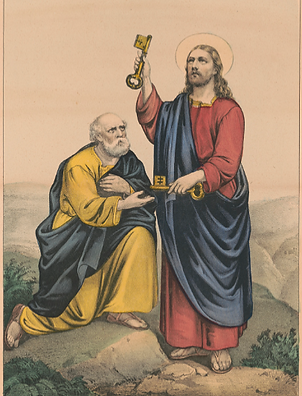
JESUS GAVE KEYS TO PETER ~
AS HEZEKIAH GAVE KEYS TO ELIAKIM


Peter ~ The New High Priest of New Jerusalem
In Isaiah 22:22, the "key of the house of David" is given to Eliakim, symbolizing authority and power within the Davidic kingdom.
Aquinas, in his writings, uses this passage to illustrate the transfer of authority and the granting of power, particularly in the context of Christ bestowing authority upon Peter. This verse describes God's action of placing the key of the house of David on Eliakim's shoulder, signifying his appointment as master of the palace, "next in line of 'authority", giving Eliakim 'authority' to open and close the entrance into the city while 'ruling' over the kingdom. This reminds us of Jesus' own words in His prayer in the sermon on the mount; "Thy kingdom come, thy will be done, on earth as it is in heaven." Eliakim, and the one he prefigured, Peter is, evidenced by Christ (the greater King David) handing the 'keys' to Peter to "bind" and "loose" (open and close) in the greater kingdom. (New Jerusalem), the Church as previously mentioned even King David spoke of ( Psalms 149:1)
Just as Hezekiah remained ruler and King of Israel at the time, so too does Jesus Christ remain ruler and King of God's kingdom on earth, as well as in heaven. So, just as when Peter died and another bishop (stewart of the kingdom) received the 'keys', Jesus maintained sovereignty and never ceased presiding over the 'greater house of David', the Church. During periods of "interregnum", a period when temporal reign (Papal rule) is suspended, especially between successive rulers, the righful King, Jesus remains head of the Church guaranteeing the Church's perpetuity.
What has never ceased is the fulfillment of Jesus command "FEED MY LAMBS." (John 21:15)
Jesus told Peter to TEACH His followers to observe ALL His commands; and in doing so, He would be with them until the consummation of the world. (Matt. 28:20)
Even during periods of "interregnum", the citizens of the kingdom, the faithful within the Church, have always had the perenial apostolic teachings to maintain their faith to receive God's grace, whether with the written word, scripture, or oral traditions passed down by previous saints, bishops, doctors, and faithful fathers, overseers of the Church since Pentecost.

St Linus - 79 A.D, St Clement - 88 A.D., St Ignatius -108 A.D., St Siricius - 350 A.D.
The list of bishops, Church leaders, historians and Saints of the Church seems endless providing clear indication that the Church not only DID NOT go into decline and apostacy as the "latter-day" reformers promote, but in fact, flourished all through the ages. And just because some proved to be unfaithful and sinned greatly, was no indication Christ abandoned His Church.
(Click on photos below)


St. Siricius, 38th Pope, left behind his original handwritten decrees preserved in Rome.
A SHORT VIDEO OF THE HISTORY OF THE CATHOLIC CHURCH BELOW.
